This blog suffers from an inevitable selection bias, as it can only feature those people in finance who agree to be interviewed. Hence, a second category of interviews with people who come into close contact with the kind of bankers who are unlikely to talk to me. Such as this elegantly dressed man in his early 40s. A psychologist by training, he has been working as an 'executive coach' for the past few years. He orders a coffee, then a glass of red wine.
"In two decades as a psychologist I have encountered perhaps half a dozen people in whom I could not detect at least something positive, if only a sliver. The psychopaths are a really rare breed. But they seduce the rest.
"I am sure your readers are familiar with psychological research comparing the personality traits of prison populations with those of successful managers. It found remarkable similarities; they are narcissistic, egocentric, manipulative … The research has been replicated over at least 12 different populations and the findings are consistent. Criminals and CEOs are remarkably similar.
"We're moving slightly beyond my field of expertise but a question I often ask myself is: who are the owners of those major banks and corporations who figured out that if they want to make so much money, they need to get a psychopath in who will then turn the entire organisation into a ruthless money-making soul-destroying machine? That's pretty clever, isn't it? To find a psychopath to do that for you?
"In youth psychology there's a well-known phenomenon regarding collective self-harming. You have a shelter that's housing, say, 50 boys. All of a sudden and apparently out of nowhere, they all start mutilating themselves. A wave. It's only natural for outsiders to assume that something must be very wrong with that shelter. However, research and experience demonstrate that all you need to do is find the one person who started it. Isolate him from the group and lo and behold, the wave stops and everything goes back to normal.
"Individuals have very powerful influence over groups, and it makes you wonder about banks and financial firms; what if they were like the shelter, and you need to find that one switch, that one person, to turn a whole group around?
"I am an optimist, humans are good animals, we have a tendency to get distracted and be led astray. As for this financial crisis, well, it's only a crisis. That's right, psychologists consider a crisis as simply one point in a cycle of growth; it's when the patient is about to make a breakthrough, and evolve.
"This is what's intriguing about the current financial crisis so far … Where are the thought leaders indicating the path to a new phase in our economic evolution? Who will augur in the growth moment from this crisis? I don't see new ideas coming to the fore.
"My clients are predominantly working in finance, aged somewhere between 32 and 47. They are the cum laude crowd who were always at the head of the pack. All of a sudden and to their astonishment, they find themselves being overtaken by less talented people; it's office politics and they don't know how to play it.
"Firms are pyramids, and a lot of talented people in their late 30s get shunted out. It's a typical bottleneck and my clients come to learn how to navigate it.
"Mid-30s is also when people are just before their mid-life crisis. They have more or less found out who they are, they can sort of see the limit of their potential, and it leads to disenchantment, disillusionment. 'I will not become the next Richard Branson', they realise. "At the same time they see that all good intentions aside, the world is tough place, and you need to be tough to survive and succeed. This is the age when you see people suddenly become serious. They have lost their innocence.
"My clients are from all over the world and they've come to London to fight. This is the top of the top, over here, and the fighting can be ruthless. My clients are the slightly more creative ones, not the standard pin stripe/porte manteau types.
"You asked me earlier what kind of animal the executive coach might be. Maybe it's a salmon, naturally inclined to swim upstream, against the current.
"I have worked in many areas of counselling, including at the very bottom of society; from illiterate heroin prostitutes to bankers. Differences? Bankers and others in the corporate world have extremely high intelligence. They think very much in transactional terms; how can this guy help me get what I want? My first consult is free, and when there's a click between us, I can see them smell a profit. They decide, if I pay this guy his fee, he will help me make much more money myself.
"They have little time so when I work with bankers I am less suggestive. I take charge of the process, lead them to where I think they should go.
"About a quarter of my clients are corporate but not finance. Is there a difference? They are all incredibly tough and everyone says their motivation is money. But when you drill down into what's driving people in the corporate world, other motives come to the surface. With people in finance, it really is money, I find.
"Finance is an amoral world, bordering on the immoral. Take the financial transaction tax. The idea: there is horrific poverty so let's levy a tiny tax and use it to alleviate that. But when I suggest to my clients this might be a good idea, I practically get lynched. No way, they say. They want to pay as little tax as possible, and that's it.
"As I said, amoral bordering on the immoral. Take the PPI mis-selling where essentially banks sold people insurance that was worthless. They get caught and the banks have to pay people their money back. Next thing you know, banks hire incredibly expensive 'consultants' to find ways to pay as little as possible.
"It's almost a perversion. The CEOs such as Fred Goodwin and Jamie Dimon and the like. They present themselves as to the outside world as posh and erudite and sophisticated; as supermen. But they are just like you and me, with similar needs and fears. We shouldn't fall for their spiel.
"What would shock readers most when they saw what I see? Let me think. How so many brilliant, arrogant, super-talented young people get abused, sucked dry, burned out and then tossed aside by corporations and banks. In the early days of capitalism it seems the game was to exploit the less gifted; miners, factory workers etc. Today it's about taking advantage of talent. People are used, then discarded. Especially these days with the crisis. Fear rules supreme. You can get fired any moment, five minutes and you're gone. Corporations fan out over universities making all these promises. But very few people make it to 'the boardroom'. That's the key concept for everyone, 'the boardroom'.
"One of the chief causes of stress is boredom. Now, those people on the trading floor, they may go through hours and hours with nothing to do. Another cause of stress is when the level of control you have over your own life is very low. Banks are managed very badly, in fact they are over-managed. Imagine you have lots of bosses and every week you're told to do your job differently. It can drive people nuts.
"For psychologists like me the world of finance is very interesting, if only in purely clinical terms. You're a CEO and you pay yourself £8m. Now, look at the kind of organisation you need to put in place in order to make that amount … It's almost dirty.
"It gets more interesting still when your company has failed on a range of issues, and at the end of the year you still pay yourself those £8m. There's an outcry but you say: 'it's in my contract'. Now, take a step back, how has that £8m become so important to you that you can't even see why you shouldn't get them? Apparently your need for the money is so strong you stop registering the anger you provoke.
"Those CEOs and managing directors at banks with their millions … They deserve our pity, really. They are the victims of their own twisted minds. And it will bring them down. Whether you are a paedophile or pervert or control freak or psychopath; sooner or later a twisted mind will turn on itself.
"For many years I worked with paedophiles. It is simply astonishing how vulpine, how cunning these people have become. The same with hard drug addicts; their brain seems to have taken on a life of its own, and developed into something so clever, so entirely focused on satisfying their needs. For those brains, lying and cheating become acceptable, normal even.
"When we treated them, or tried to, the key was to make them realise that they created victims, that people suffered because of them. One thing that struck me about this group of patients – we'd call them 'clients' – was how they seemed to derive immense pleasure from surreptitiously screwing people over, then getting away with it. At the same time they seemed to have a deep urge to get caught.
"The biggest misunderstanding about the people I work with? That they are going to solve this.
"The truth is, there is no system, there is no 'they'. There are just individuals."
• Follow @JLBankingBlog on Twitter
Horizon Technology Finance Set to Join Russell 3000 Index - msnbc.com
FARMINGTON, Conn., June 18, 2012 (GLOBE NEWSWIRE) -- Horizon Technology Finance Corporation (Nasdaq:HRZN) (the "Company" or "Horizon"), a leading specialty finance company that provides secured loans to venture capital and private equity backed development-stage companies in the technology, life science, healthcare information and services, and clean-tech industries, today announced that it is set to join the broad-market Russell 3000(R) Index when Russell Investments reconstitutes its comprehensive set of U.S. and global equity indexes on June 25, 2012. Based on its membership in the Russell 3000 Index, which remains in place for one year, Horizon will also automatically be included in the widely followed Russell 2000(R) Index for U.S. small-cap stocks.
Annual reconstitution of Russell's U.S. indexes captures the 4,000 largest U.S. stocks as of the end of May, ranking them by total market capitalization. The Russell indexes are widely used by investment managers and institutional investors for index funds and as benchmarks for both passive and active investment strategies. In the institutional marketplace, an industry-leading $3.9 trillion in assets currently are benchmarked to the Russell indexes.
Robert D. Pomeroy, Jr., Chairman and Chief Executive Officer of Horizon, said, "We are excited to join the Russell family of indexes, significantly increasing Horizon's visibility in the investment community. Our membership represents an important milestone for Horizon that reflects the considerable success we have achieved in the execution of our investment strategy. As we maintain our focus on taking advantage of high-quality investment opportunities and generating attractive risk-adjusted returns, our inclusion in these key investment benchmarks will help further expand our Company's shareholder base."
The Russell 3000 also serves as the U.S. component to the Russell Global Index, which Russell launched in 2007. Total returns data for the Russell 3000 and other Russell Indexes is available at http://www.russell.com/indexes/data/US_Equity/Russell_US_Index_returns.asp .
About Horizon Technology Finance
Horizon Technology Finance Corporation is a business development company that provides secured loans to development-stage companies backed by established venture capital and private equity firms within the technology, life science, healthcare information and services, and clean-tech industries. The investment objective of Horizon Technology Finance is to maximize total risk-adjusted returns by generating current income from a portfolio of directly originated secured loans as well as capital appreciation from warrants to purchase the equity of portfolio companies. Headquartered in Farmington, Connecticut, with a regional office in Walnut Creek, California, the Company is externally managed by its investment advisor, Horizon Technology Finance Management LLC. Horizon's common stock trades on the NASDAQ Global Select Market under the ticker symbol "HRZN." In addition, the Company's 7.375% Senior Notes due 2019 trade on the New York Stock Exchange under the ticker symbol "HTF." To learn more, please visit www.horizontechnologyfinancecorp.com .
About Russell
Russell Investments ("Russell") is a global asset manager and one of only a few firms that offers actively managed, multi-asset portfolios and services that include advice, investments and implementation. Working with institutional investors, financial advisors and individuals, Russell's core capabilities extend across capital markets insights, manager research, Indexes, portfolio implementation and portfolio construction.
Russell has approximately $155 billion in assets under management (as of 3/31/2012) and works with 2,400 institutional clients, more than 580 independent distribution partners and advisors, and individual investors globally. Founded in 1936, Russell is a subsidiary of The Northwestern Mutual Life Insurance Company.
Forward-Looking Statements
Statements included herein may constitute "forward-looking statements," which relate to future events or our future performance or financial condition. These statements are not guarantees of future performance, condition or results and involve a number of risks and uncertainties. Actual results may differ materially from those in the forward-looking statements as a result of a number of factors, including those described from time to time in our filings with the Securities and Exchange Commission. The Company undertakes no duty to update any forward-looking statement made herein. All forward-looking statements speak only as of the date of this press release.
CONTACT: Horizon Technology Finance Corporation Christopher M. Mathieu Chief Financial Officer (860) 676-8653 chris@horizontechfinance.com Investor Relations and Media Contacts: The IGB Group Leon Berman / Michael Cimini (212) 477-8438 / (212) 477-8261 lberman@igbir.com / mcimini@igbir.com
© Copyright 2012, GlobeNewswire, Inc. All Rights Reserved
The Absurd Things George Zimmerman And His Wife Did To Try To Keep Their Money Secret - TPM
It didn’t take an expert cryptographer or even a secret decoder ring to figure out George Zimmerman really wasn’t talking about Peter Pan during jailhouse phone calls with his wife in April.
In hushed conversations from a Seminole County, Fla., jail, the man charged with second-degree murder in the killing of unarmed teenager Trayvon Martin was instructing his wife how to transfer huge amounts of money between bank accounts and allegedly out of the gaze of local authorities.
The name “Peter Pan,” in this case, appears to have been code for the company PayPal. Zimmerman was using the online banking service to raise hundreds of thousands of dollars from supporters who believed he was either a hero of gun rights or a man being railroaded by a corrupt justice system.
Clumsy and obvious, the code was just one of several tactics that verged on the absurd that the Zimmermans used to try to keep their fundraising secret from authorities. The tactics were brought to light on Monday when prosecutors released audio recordings of six jailhouse phone calls between Zimmerman and his wife.
The calls, along with dozens of pages of bank records, showed the contortions the couple went through in April to keep their fundraising on the down low.
“Um, I asked Ken to double up on it, do, you know, $10 in the morning and then $10 in the evening,” George Zimmerman said to his wife during one of the calls released Monday. “And that way you can put, you know, into mine and then you can take uh 10 for you and 10 for her for Susie.”
“Okay, why can’t he just do both of ‘em?” Shellie Zimmerman replied.
“Because he can only take it from Peter Pan to mine.”
“Oh okay, okay, right.”
But those efforts, prosecutors have since said, went from comical to criminal just a few days later when Shellie Zimmerman took to the witness stand at her husband’s bond hearing and claimed ignorance about how much had been raised using a homemade website and the PayPal account.
She did so, prosecutors allege, to trick the judge into letting her husband out of jail on a very low bond amount. This month, those same prosecutors charged Shellie Zimmerman with perjury, pointing to the calls as proof that she not only knew about the money but had been involved in its administration.
The newly released calls showed just how involved Shellie Zimmerman was in transferring money between bank accounts. In one phone call, she could be heard at what sounds like a bank. She even put her husband on the line with an employee there to make sure they had the right permissions in place for her to access their accounts.
Often, the couple used low dollar figures in their conversations. Prosecutors have said said that, too, was something of an unsophisticated code. In reality, the Zimmermans were referring to amounts that were 1,000 times higher than the figures they were using.
The calls and bank records appear to back that up. For example, George Zimmerman can be heard in one of the recordings making sure that his wife is transferring “less than $10” between accounts. In turn, bank records show, many of the transfers between accounts hovered just below $10,000. Sometimes they were just $1 or $10 below that threshold.
The specific amounts of those transfers, it turns out, may be even more problematic for the Zimmermans, too. For decades, there have been laws in place designed to fight money laundering that require banks to notify federal authorities any time a customer makes a cash transaction of $10,000 or more.
But because people eventually got around the law by cleverly using multiple transactions of $9,999 or less, the federal government later made it illegal to try to avoid detection by doing that.
It’s unclear whether that’s what the Zimmermans were trying to do by transferring such odd amounts between bank accounts. But the bank records clearly show a pattern. On April 16, for instance, the records show two transfers for exactly $9,999 and one for $9,990. Eight days later, the records show an eighth transaction of $9,999 and a ninth for $5,587.92.
Florida criminal defense attorney James Felman told TPM on Monday the figures definitely raise red flags.
“It certainly is odd that someone would persist in multiple transactions in an amount just under that threshold,” said Felman, who has no connection to the Zimmerman case and was speaking simply as an observer.
However, he also noted the law here was designed to flag suspicious cash transactions and it may not apply to electronic transfers between bank accounts like what the Zimmermans were doing. Still, he said, amounts would be enough to pique an investigator’s interests.
“It certainly is sufficiently suspicious to kind of call upon him to give an explanation for it,” Felman said.
 Nick R. Martin
 Nick Martin is a reporter for TPMMuckraker. He comes to the site from Arizona, where he worked as a freelance journalist, investigating serial killers, extremist groups, politicians and scoundrels of all stripes for a variety of local and national news outlets. He also operated the award-winning news blog, Heat City. Contact him: nick [at] talkingpointsmemo.com
Hedge fund group Man appoints Jonathan Sorrell as finance director - The Guardian
The troubled hedge fund group Man has replaced its finance director with Jonathan Sorrell, one of the sons of the WPP boss Sir Martin Sorrell, in an effort to shore up its flagging performance.
On its first day of trading after being relegated from the FTSE 100, Man surprised the market by naming the 34-year-old one-time Goldman Sachs banker as a replacement for Kevin Hayes, who had held the job for the past five years. Hayes is entitled to one year's salary of £400,000 but none of the bonuses that pushed his pay to £1.5m last year.
Sorrell, the middle son of the WPP boss, joined Man last year as head of strategy from Goldman, where he built Petershill investment vehicle, which invests in the management companies of hedge funds.
He is expected to embark on a rigorous cost-cutting exercise to try to restore the fortunes of the hedge fund group. His pay will not be disclosed until next year.
 Source: Yahoo finance
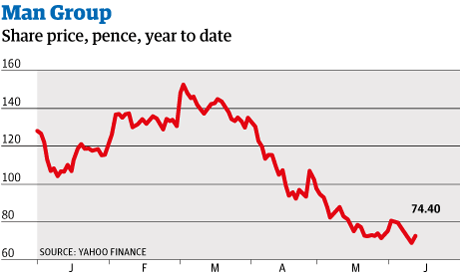
 Shares in Man have been pummelled during the financial crisis, slumping from 605p in 2007 to just 74.4p on Monday – a slump that cost the company its place in the FTSE 100 last Friday.
At the heart of its problems is its once-popular "black box" fund, AHL, which is losing investors and finding it difficult to attract new customers. It accounts for as much as two-thirds of the group's revenue, even though Man bought its rival GLG two years ago in an effort to diversity its business range.
The Numis analyst David McCann described investing in Man as "in the same category as red on the roulette wheel".
Sorrell was involved in Man's recent acquisition of the investment firm Financial Risk Management, which is intended to diversify its business.
Peter Clarke, the under-fire chief executive of Man, cited Sorrell's role in this Financial Risk Management deal as one of the reasons for his promotion.
"He has a strong background in strategy and execution, and will bring clear focus on costs and financial efficiency," he said.
Analysts at Bank of America Merrill Lynch said it was "hard to lay [the blame]" on the departing Hayes for the weak industry backdrop and the poor performance of AHL.
"We think there is nothing about Man which a period of good AHL performance would not fix. That said, we suspect that Mr Sorrell, as a relative outsider, will be able to look at the company's overall cost structure with a fresh pair of eyes."
Analysts at Credit Suisse also expect Sorrell to start cutting costs more aggressively, saying: "Whilst the new FD [finance director] will not change the challenges that Man and the wider industry face overnight, we believe the change may provide a fresh perspective on the business and allow new ideas to be considered in driving the business forward."
Sir Martin Sorrell, who took home a total of £13m in 2011, faced a protest vote last week over a 30% rise in his salary to £1.3m when more than 60% of shareholders voted against WPP's remuneration report at the annual meeting in Dublin. Senior board members from WPP are now embarking on a series of meetings with investors after the stinging defeat – the latest executive pay policy to be rejected during the "shareholder spring".
Tough luck, Generation X: Only half of wealthy Baby Boomers to leave money for their kids...and ONE THIRD would rather give it to charity - Daily Mail
- Baby Boomers defined as people between the ages of 47 and 66
- Generation X refers to people born between early 1960s and early 1980s
- 55 per cent of Baby Boomers believe it's important to leave money to offspring
- Most Baby Boomers believe each generation should earn its own wealth
- Three-quarters of people younger than 46 favor leaving money to kids
|
When members of the Baby Boomers generation die in the next 50 years, they will leave trillions of dollars in wealth behind, but their children should not hold their breath for a large inheritance.
According to the U.S. Trust Insights on Wealth and Worth annual study released on Monday, only 55 per cent of Baby Boomers - those between the ages of 47 to 66 - think it is important to leave money for their offspring.
U.S. Trust commissioned an independent, national survey of 642 high net worth adults, who were not clients, with at least $3million in investable assets.

Givers: A study found that 31 per cent of wealthy Baby Boomers would prefer to leave their money to charity
One of three Baby Boomers surveyed – about 31 per cent - don’t think it is important to leave a financial inheritance and said they would rather leave money to charity than to their children.
By contrast, three-quarters of wealthy people under age 46 said it's a priority to leave inheritance for their children.
The top reason for not wanting to leave money for their kids is the belief shared by some Baby Boomers that each subsequent generation should work to earn its own wealth.
Following closely behind is the thought that it is more important to invest in children’s success while they are growing up.
‘Our survey points to a shift in generational behavior and outlook, most likely shaped by personal experience and societal responses to economic realities,’ said Keith Banks, president of U.S. Trust.
Banks added that well-off parents are concerned that the next generation is not prepared to inherit wealth, which is not surprising considering the fact that most of the Baby Boomers surveyed don't talk to their kids about money: just 37 per cent said they've fully disclosed their net worth to their children.

Kept in the dark: Just 37 per cent of Baby Boomers said they've fully disclosed their net worth to their kids
Those over age 67 said they weren't having this discussion because they were raised to avoid money talk, while younger respondents said they didn't want to inhibit their kids' work ethic.
Unlike the majority of people from her generation, 63-year-old Kathleen Taylor, of Chimacum, Washington, taught her two grown children since they were young to be responsible for their own money.
That is why she plans to leave most of her money to her children and some money to charitable causes, ABC News reported.
One way Taylor and her husband taught their children about responsible spending was providing the value of college tuition, room and board to each of them and putting them in charge of paying the bills.
‘People thought we were crazy,’ she told ABC.
The Taylors plan to start a college fund once their children start having their own kids. And they intend to add to it on their grandchildren’s birthdays as long as Taylor and her husband are alive.
Mrs Taylor said she hopes her own children will do the same for their great-grandchildren.
The U.S. Trust study also has found that 42 per cent of Baby Boomers and 54 per cent of those under age 46 are paying medical costs for their parents or other relatives.
German finance minister welcomes Greek conservatives' win as decision to push on with reform - Greenfield Daily Reporter
BERLIN — Germany's finance minister greeted the conservative New Democracy party's projected win in Greek elections Sunday as a decision to "forge ahead" with implementing far-reaching reforms. Germany's foreign minister said it's important for Greece to stick to its agreements with creditors, but held out the prospect that Athens might be given more time to comply with them.
New Democracy party beat the radical-left Syriza party into second place on Sunday and immediately proposed forming a pro-euro coalition government — a development that eased, at least briefly, fears that the vote would unleash economic chaos.
Germany — Europe's biggest economy — has been a major contributor to Greece's 2 multibillion-euro rescue packages and a key advocate of demanding tough, and highly unpopular, austerity and reform measures in exchange.
If New Democracy's win is confirmed, Germany "would consider such a result a decision by Greek voters to forge ahead with the implementation of far-reaching economic and fiscal reforms in the country," German Finance Minister Wolfgang Schaeuble said in a statement.
The austerity and reform program aims only "to put the country back on the path of economic prosperity and stability," he added. "This path will be neither short nor easy but is necessary and will give the Greek people the prospect of a better future."
"In order to succeed, the program requires political stability," Schaeuble said.
Foreign Minister Guido Westerwelle told ARD television earlier Sunday, shortly after exit polls showed a neck-and-neck race, that "we want Greece to stay in the euro; we want Greece to continue wanting to belong to Europe." But he stressed that it was for Greece to decide on its future path, and said that "you cannot stop anyone who wants to go."
Westerwelle said it was important for Greece to form a pro-European government that sticks to the agreements with creditors.
Debt inspectors from the EU, the European Central Bank and the IMF who are managing the Greek bailout regularly check progress in implementing its conditions to determine whether Greece can secure further aid payouts. Westerwelle insisted that the substance of the bailout agreements must remain unchanged, but signaled some flexibility on deadlines.
"There cannot be substantial changes to the agreements, but I can well imagine talking again about timelines, against the background of the fact that, in reality, there was a political standstill in Greece over recent weeks because of the elections," he said. "But there is no way past the reforms — Greece must stand by what has been agreed."
Finance, commerce ministers spar over trade policy - Times of India
While the issue is being dealt with at the official level, when asked, commerce & industry minister Anand Sharma said that no announcement was made without finance minister Pranab Mukherjee's approval. On their part, his officials said the finance ministry was raking up issues that did not have merit. North Block has said that changes announced in the Export Promotion Capital Goods (EPCG) scheme, the Served from India Scheme (SFIS) and changes in the verification norms were done without the finance ministry's approval.
A turf war between the revenue department and the directorate general of foreign trade (DGFT) was the norm for years, although it had changed in recent past. But this year, the revenue department has gone back to its old ways. In most cases, commerce department officials said in case of EPCG the finance ministry merely had concerns over the language and there was no scope for misuse. The revamped policy has said that exporters can import capital goods on payment of advance duty, but the finance ministry's concern is that the mode of payment, which will be in cash, is not mentioned.
Similarly, in case of SFIS, the finance ministry had overlooked a notification that was issued in January 2011, while accusing the commerce ministry of not consulting it. "What should we do? Ignore notifications that have been issued since the policy was announced in 2009?" asked an official, while pointing out that one of the main goals of this years trade policy was to simply the procedures.
In the same vein, DGFT had done away with mandatory verification of duty credit scrips as the government had failed to put in place an electronic data interchange set-up as was promised. "This is a major step towards cost reduction. What we are saying is that it is not mandatory. We are not saying that customs department will not check the genuineness, which it is expected to do. That data is available and it can still be done," an official said.
Man Group finance director Kevin Hayes steps down - BBC News
Kevin Hayes has stepped down as finance director of struggling hedge fund firm Man Group on the day the company is demoted from the FTSE 100.
Jonathan Sorrell, Man's head of strategy and corporate finance, will replace him at Europe's largest listed hedge fund.
Man, whose shares have slumped, is being replaced in the FTSE 100 list of the UK's leading companies by Babcock.
Mr Hayes is leaving to pursue "other interests", Man said in a statement.
He joined Man in 2007.
Man Group shares have tumbled since the last FTSE review in March, and are down almost two-thirds since last year.
The firm's funds have struggled as cautious clients withdraw money because of the market turmoil caused by the eurozone debt crisis.
Mr Sorrell, son of WPP advertising chief Sir Martin Sorrell, spent more than a decade at Goldman Sachs before joining Man last August.
In a statement, Man chief executive Peter Clarke said Mr Sorrell's experience "will be extremely valuable as we continue to develop and evolve in challenging world markets".

I know it's just your headline writer I'm taking issue with here and not the author of the piece, but in general most of the children of the Boomers fall into the generation know as Gen Y / The Millenials. Gen X's parents are to be found with higher frequency among the Silent Generation.
- Patrick, Miami, Florida, USA, 18/6/2012 19:47
Report abuse